Get Free Ebook Traction: A Startup Guide to Getting Customers, by Gabriel Weinberg, Justin Mares
Why need to be Traction: A Startup Guide To Getting Customers, By Gabriel Weinberg, Justin Mares in this site? Get a lot more revenues as what we have told you. You can locate the other eases besides the previous one. Ease of obtaining guide Traction: A Startup Guide To Getting Customers, By Gabriel Weinberg, Justin Mares as exactly what you desire is also provided. Why? We offer you lots of type of guides that will not make you feel weary. You could download them in the web link that we offer. By downloading and install Traction: A Startup Guide To Getting Customers, By Gabriel Weinberg, Justin Mares, you have taken properly to select the ease one, as compared to the inconvenience one.
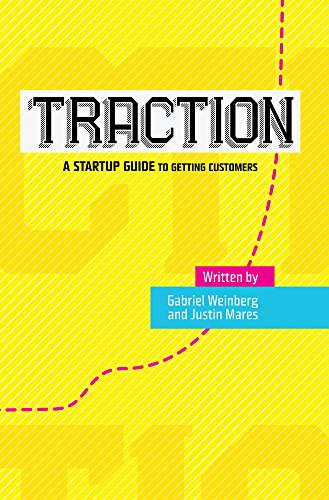
Traction: A Startup Guide to Getting Customers, by Gabriel Weinberg, Justin Mares

Get Free Ebook Traction: A Startup Guide to Getting Customers, by Gabriel Weinberg, Justin Mares
Traction: A Startup Guide To Getting Customers, By Gabriel Weinberg, Justin Mares. Negotiating with checking out routine is no demand. Checking out Traction: A Startup Guide To Getting Customers, By Gabriel Weinberg, Justin Mares is not kind of something sold that you could take or not. It is a point that will transform your life to life a lot better. It is the important things that will offer you numerous points worldwide as well as this universe, in the real world as well as right here after. As just what will be offered by this Traction: A Startup Guide To Getting Customers, By Gabriel Weinberg, Justin Mares, how can you negotiate with the important things that has numerous benefits for you?
As we specified in the past, the modern technology assists us to consistently recognize that life will be consistently simpler. Checking out e-book Traction: A Startup Guide To Getting Customers, By Gabriel Weinberg, Justin Mares habit is additionally among the perks to get today. Why? Technology can be made use of to provide the publication Traction: A Startup Guide To Getting Customers, By Gabriel Weinberg, Justin Mares in only soft data system that can be opened up every single time you really want and everywhere you require without bringing this Traction: A Startup Guide To Getting Customers, By Gabriel Weinberg, Justin Mares prints in your hand.
Those are a few of the benefits to take when obtaining this Traction: A Startup Guide To Getting Customers, By Gabriel Weinberg, Justin Mares by on-line. But, exactly how is the means to obtain the soft documents? It's very appropriate for you to visit this page because you can get the link page to download guide Traction: A Startup Guide To Getting Customers, By Gabriel Weinberg, Justin Mares Just click the web link supplied in this write-up as well as goes downloading. It will not take significantly time to obtain this book Traction: A Startup Guide To Getting Customers, By Gabriel Weinberg, Justin Mares, like when you have to go with publication establishment.
This is additionally one of the reasons by getting the soft file of this Traction: A Startup Guide To Getting Customers, By Gabriel Weinberg, Justin Mares by online. You may not need even more times to spend to go to the book store and hunt for them. Sometimes, you likewise do not find guide Traction: A Startup Guide To Getting Customers, By Gabriel Weinberg, Justin Mares that you are browsing for. It will squander the time. However right here, when you see this page, it will be so easy to obtain and download and install guide Traction: A Startup Guide To Getting Customers, By Gabriel Weinberg, Justin Mares It will certainly not take sometimes as we explain before. You can do it while doing something else at house or perhaps in your office. So very easy! So, are you doubt? Merely exercise what we provide here as well as check out Traction: A Startup Guide To Getting Customers, By Gabriel Weinberg, Justin Mares exactly what you enjoy to review!
Most startups end in failure.� Almost every failed startup has a product. What failed startups don't have is traction -- real customer growth.
This book introduces startup founders and employees to the "Bullseye Framework," a five-step process successful companies use to get traction. This framework helps founders find the marketing channel that will be key to unlocking the next stage of growth.
Traction is a guide to getting customers, written for startup founders, marketers, and those interested in how today's startups grow and get traction. This book shows you how the founders of several of the biggest companies and organizations in the world like Jimmy Wales (Wikipedia), Alexis Ohanian (Reddit), Paul English (Kayak.com) and Alex Pachikov (Evernote) have built and grown their startups. We interviewed over forty successful founders and researched countless more growth stories to pull out the repeatable tactics and strategies they used to get traction.
"Many entrepreneurs who build great products simply don't have a good distribution strategy." -- Mark Andreessen, venture capitalist
Too often, startups spend months (or years) building a product only to struggle with traction once they launch. This struggle has startups trying random tactics - some ads, a blog post or two - in an unstructured way that leads to failure. Traction shows readers how to systematically approach marketing, and covers how successful businesses have grown through each of the following channels:
Viral Marketing
Public Relations (PR)
Unconventional PR
Search Engine Marketing (SEM)
Social and Display Ads
Offline Ads
Search Engine Optimization (SEO)
Content Marketing
Email Marketing
Engineering as Marketing
Target Market Blogs
Business Development (BD)
Sales
Affiliate Programs
Existing Platforms
Trade Shows
Offline Events
Speaking Engagements
Community Building
This book draws on interviews we conducted with the following individuals:
Jimmy Wales, Co-founder of Wikipedia
Alexis Ohanian, Co-founder of reddit
Eric Ries, Author of The Lean Startup
Sam Yagan, Co-founder of OkCupid and CEO of Match.com
Jason Cohen, Founder of WP Engine
Chris Fralic, Partner at First Round Capital
Rand Fishkin, Founder of SEOmoz
Noah Kagan, Founder of AppSumo
Jason Kincaid, Blogger at TechCrunch
Alex Pachikov, Co-founder of Evernote�
Ryan Holiday, Exec at American Apparel
Andrew Warner, Founder of Mixergy
Garry Tan, Partner at Y Combinator
and many more.
- Sales Rank: #117457 in Books
- Published on: 2014-08-25
- Released on: 2014-08-25
- Number of items: 1
- Binding: Hardcover
- 258 pages
Review
"This is a must-have, essential book if you want to be good at growth."�- Aaron Ginn, Growth at StumbleUpon
"Traction is an absolute must. The Bullseye Framework Gabe and Justin layout is probably the greatest tool in my catalog over the past year. Whether you are a seasoned entrepreneur or just getting started, Traction offers a framework that creates efficiency, clarity, and focus. With startups as crazy as they are, I strongly encourage you to take the time to make your life a little easier. Traction is equal to and should be read alongside The Lean Startup."�- Adam Kearney, Founder & CEO, Saunter
"Traction is a critical guide for entrepreneurs looking to grow and scale their businesses." �- Patrick Vlaskovits, bestselling author of The Lean Entrepreneur
"I've read quite a few books about startups over the years, and apparently this was the only one worth keeping."�-�Chris Stucchio, Data Scientist
"Traction belongs on every startup founder’s bookshelf. I’m buying copies for the CEOs of my current Angel Investments."�- Kevin Dewalt, Angel Investor
"Anyone--founders, managers, and executives--trying to break through to new customers can use this smart, ambitious book."�— Eric Ries, bestselling author of The Lean Startup
“Here is the inside scoop, the latest, most specific tactics from the red-hot center of the internet marketing universe. From someone who has done it. Twice.”�— Seth Godin, bestselling author of Linchpin
“The entrepreneurs who walk out of our offices with term sheets walk into them with Traction. It's a pragmatic guide to solving the entrepreneur's number one challenge.”�— Fred Wilson, cofounder of Union Square Ventures
“The question every founder asks after shipping is always: how do I get traction? This book actually answers it.”�— Alexis Ohanian, cofounder & Executive Chairman of reddit
"A common question I get is:� 'How do I know if my business is getting traction, or how do I get traction for my business, or how do I get users?' Traction answers all of these questions and more.”�— James Altucher, bestselling author of Choose Yourself
About the Author
Gabriel Weinberg is the Founder & CEO of DuckDuckGo, the search engine that doesn't track you with over a billion searches in 2013. He is also an angel investor in early stage startups. Weinberg has been featured on CBS, FOX, the Guardian, the Washington Post and many more. Previously he was the Co-founder & CEO of Opobox, which was sold to United Online in 2006. Weinberg holds B.S. in Physics and an M.S. in Technology and Policy from MIT. He is based on Valley Forge, PA with his wife and two boys.
Justin Mares is the former Director of Revenue at Exceptional, a software company that Rackspace acquired for 8 figures in 2013. He has previously founded two startups (one acquired, one bust) and runs a growth meetup in San Francisco. You can find his writing on marketing and personal-development on his blog, justinmares.com.
Excerpt. � Reprinted by permission. All rights reserved.
�
Preface: Traction Trumps Everything
In 2006 I sold for millions of dollars an Internet company that I had cofounded a few years earlier. It was a strange company for many reasons, not the least of which was that we had no employees from beginning to end. I wrote every line of code and did all the accounting and customer support.
The terms of the deal were such that my cofounder and I didn’t have to work for the acquiring company at all. We were free to move on to other things, and we did. A few months later my wife and I moved from our 865-square-foot apartment near Boston to a country house twenty-five miles outside of Philadelphia. I had just turned twenty-seven.
She went to her job and I sat at home doing nothing for the first time in my life. We knew no one for a hundred miles in any direction.
Naturally, I started tinkering on the computer again, starting about a dozen side projects simultaneously. A year and a half later, I thought I was on to something. I noticed two things that bothered me about Google: too much spam (all those sites with nothing but ads) and not enough instant answers (I kept going to Wikipedia and IMDb). I thought if I could easily pick out the spam and the answers, then I’d have a more compelling search engine.
Both problems were harder to solve than I initially thought, but I thoroughly enjoyed the work and kept at it. Everyone I talked to about my search engine project thought I was nuts. You’re doing what? Competing against Google? Why? How? Another year later, in the fall of 2008, I flipped the switch, unveiling my search engine to the public.
DuckDuckGo had a rather uneventful launch, if you can even call it a launch. I posted it to a niche tech site called Hacker News and that was the long and short of it. The post was entitled “What do you think of my new search engine?”
Like many entrepreneurs, I’m motivated by being on the cusp of something big, and I was at the point where I needed some validation. I can survive on little, but I needed something.
I got it.
Granted, the product wasn’t anything you’d want to switch to at that point, and people let me know that. It was an Internet forum, after all. However, I still felt there was genuine interest in a new search competitor. I could tell some people were growing wary of what Google was becoming. For example, those initial conversations led me to investigate search privacy and eventually become “the search engine that doesn’t track you,” years before government and corporate surveillance became a mainstream issue.
In any case, the response I received was enough motivation to keep me going. Which brings me to traction. I needed some.
Traction is the best way to improve your chances of startup success. Traction is a sign that something is working. If you charge for your product, it means customers are buying. If your product is free, it’s a growing user base.
Traction is powerful. Technical, market, and team risks are easier to address with traction. Fund-raising, hiring, press, partnerships, and acquisitions all become much easier.
In other words, traction trumps everything.
My last startup had grown using two traction channels: first, search engine optimization (ranking high in search engines for relevant terms), and later, viral marketing (where your customers bring in other customers, such as by referring friends and family through use of the product).
Viral marketing doesn’t work well in search because you can’t easily bake it into the product by putting stuff between people and their search results. So I tried search engine optimization. The terms “search engine” and “search engines” were too hard to rank for, as the high-ranking companies had been around for a decade and had tens of thousands of links pointing at them from their long histories. “New search engine” was more in my grasp.
I worked hard for many months to rank high for this phrase. The key to good search engine optimization (SEO) is getting links. As you will read later in the SEO chapter, you need a strategy to get these links in a scalable way.
Getting stories written about you in blogs and news outlets is a common SEO linking strategy. However, I hit saturation with that channel strategy pretty quickly and it didn’t get me to the top. Something more creative was required.
After much brainstorming and experimenting, I eventually hit upon a good idea. I built a karma widget that would display links to your social media profiles and how many followers you had on each service. People would embed it on their sites and at the bottom there would be a link back to DuckDuckGo that said “new search engine.”
This channel strategy worked beautifully. I was number one.
Trouble was, not a ton of people make that search—about fifty a day. So while I did get some traction and a steady stream of new users, it leveled off pretty quickly. It wasn’t enough traction to be meaningful. It didn’t move the needle.
I made two large traction mistakes here. First, I failed to have a concrete traction goal. In retrospect, to move the needle for my traction goals at the time, I needed more like five thousand new visitors a day, not fifty. Search engine optimization was not going to get me there.
Second, I was biased by my previous experience. Just because my last company got traction in this way didn’t mean it was right for every company.
These are very natural mistakes to make. In fact, most startups make them. The most common startup trajectory now goes something like the following:
Founders have an idea for a company they’re excited about. Initial excitement turns into a struggle to build a product, but they do get something out the door.
Launch!
The founders expected customers to beat a path to their door, but unfortunately that isn’t happening. Getting traction was an afterthought, but now they are focused on it. They try what they know or what they’ve heard others do: some Facebook ads, a little local PR, and maybe a smattering of blog posts.
Then they run out of money and the company dies.
Sadly, this is the norm. Even sadder, often these products are actually on to something. That is, with the right traction strategy they might have actually been able to get traction and not go out of business.
Given my previous startup success I thought I knew what I was doing. I was wrong. Luckily, I wasn’t dead wrong. I had the money to self-fund through my traction mistakes, and so they didn’t prove fatal for DuckDuckGo. Not everyone is as lucky.
Right when I realized I was making these mistakes I also realized I didn’t know the right way to go about getting traction at all. I asked around. It turns out there was no good framework for getting traction, and that’s how this book was born, way back in 2009.
Around this time I also started angel investing and more seriously advising other startups. I saw firsthand similar struggles and mistakes. I also partnered with Justin Mares, my coauthor. Justin founded two startups (one of which was acquired) and recently ran growth at Exceptional Cloud Services, which was acquired by Rackspace in 2013 for millions. He’s a growth expert in his own right.
We set out to help startups get traction no matter what business they were in: from Internet companies to local small businesses and everything in between. We drew on our personal experiences, interviewed more than forty founders, studied many more companies, and pulled out the repeatable framework they used to succeed.
That framework is Bullseye, a simple three-step process for getting traction. Bullseye works for startups of all kinds: consumer or enterprise focused, large or small.
Since DuckDuckGo’s humble beginnings, we have grown five orders of magnitude (10x growth spurts), from that initial one hundred searches a day to now over ten million a day. Each step—from 100 to 1,000, 10,000 to 100,000, 1,000,000 to 10,000,000—involved figuring out how to get traction again. That’s because, as you will see, often what works in one growth stage eventually stops working.
Thankfully we had Bullseye to help us find the right traction channel strategy at the right time. After my search engine optimization mistake, we shifted to using content marketing, social and display ads, publicity, and most recently business development. We’ve hit the bull’s-eye repeatedly, and so can you.
CHAPTER ONE
Traction Channels
Before we get started, let’s define traction. Traction is a sign that your company is taking off. It’s obvious in your core metrics: If you have a mobile app, your download rate is growing rapidly. If you’re running a subscription service, your monthly revenue is skyrocketing. If you’re an organic bakery, your number of transactions is increasing every week. You get the point.
Naval Ravikant, founder of AngelList, an online platform that helps companies raise money, says it well:
Traction is basically quantitative evidence of customer demand. So if you’re in enterprise software, [initial traction] may be two or three early customers who are paying a bit; if you’re in consumer software the bar might be as high as hundreds of thousands of users.
You can always get more traction. The whole point of a startup is to grow rapidly. Getting traction means moving your growth curve up and to the right as best you can. Paul Graham, founder of startup accelerator Y Combinator, puts it like this:
A startup is a company designed to grow fast. Being newly founded does not in itself make a company a startup. Nor is it necessary for a startup to work on technology, or take venture funding, or have some sort of “exit.” The only essential thing is growth. Everything else we associate with startups follows from growth.
Traction is growth. The pursuit of traction is what defines a startup.
After interviewing more than forty successful founders and researching countless more, we discovered that startups get traction through nineteen different channels. Many successful startups experimented with multiple channels until they found one that worked.
We call these customer acquisition channels traction channels. These are marketing and distribution channels through which your startup can get traction: real customer growth.
We uncovered two broad themes through our research. First, most founders consider using only traction channels with which they’re already familiar, or those they think they should be using because of their type of product or company. This means that far too many startups focus on the same channels and ignore other promising ways to get traction. In fact, often the most underutilized channels in an industry are the most promising ones.
Second, it’s hard to predict the traction channel that will work best. You can make educated guesses, but until you start running tests, it’s difficult to tell which channel is the best one for you right now.
Our introductory chapters 2–5 expand on these themes. Chapter 2 introduces you to traction thinking: the mind-set you need to adopt to maximize your chances of getting traction. Chapter 3 presents our framework for getting traction called Bullseye. Essentially, it involves targeted experimentation with a few traction channels, followed by laser focus on the core channel that is most promising.
Chapter 4 explains how to go about running traction tests, a central theme of Bullseye. Chapter 5 presents a second framework—called Critical Path—to help you focus on the right traction goal and ignore everything else not required to achieve it.
Before you jump into this material, however, we’d like to introduce you to the nineteen traction channels and some of the people we interviewed for them. We will explore each of these channels in chapters 6–24.
When going through the traction channels, try your best not to dismiss them as irrelevant for your company. Each traction channel has worked for startups of all kinds and phases. As mentioned, the right channel is often an underutilized one. Get one channel working that your competitors dismiss, and you can grow rapidly while they languish.
Targeting Blogs
Popular startups like Codecademy, Mint, and reddit all got their start by targeting blogs. Noah Kagan, Mint’s former director of marketing, told us how he targeted niche blogs early on, and how this strategy allowed Mint to acquire forty thousand customers before launching.
Publicity
Publicity is the art of getting your name out there via traditional media outlets like newspapers, magazines, and TV. We interviewed Jason Kincaid, former TechCrunch writer, about pitching media outlets, how to form relationships with reporters, and what most startups do wrong when it comes to publicity. We also talked with Ryan Holiday, media strategist and bestselling author of Trust Me, I’m Lying, to learn how startups could leverage today’s rapidly changing media landscape to get traction.
Unconventional PR
Unconventional PR involves doing something exceptional like publicity stunts to draw media attention. This channel can also work by repeatedly going above and beyond for your customers. Alexis Ohanian told us some of the things he did to get people talking about reddit and Hipmunk, two startups he cofounded.
Search Engine Marketing
Search engine marketing (SEM) allows companies to advertise to consumers searching on Google and other search engines. We interviewed Matthew Monahan of Inflection, the company behind Archives.com (before its $100 million acquisition by Ancestry.com), to learn how Archives relied primarily on SEM for its growth.
Social and Display Ads
Ads on popular sites like reddit, YouTube, Facebook, Twitter, and hundreds of other niche sites can be a powerful and scalable way to reach new customers. We brought in Nikhil Sethi, founder of the social ad buying platform Adaptly, to talk with us about getting traction with social and display ads.
Offline Ads
Offline ads include TV spots, radio commercials, billboards, infomercials, newspaper and magazine ads, as well as flyers and other local advertisements. These ads reach demographics that are harder to target online, like seniors, less tech-savvy consumers, and commuters. Few startups use this channel, which means there’s less competition for many of these audiences. We talked with Jason Cohen, founder of WP Engine and Smart Bear Software, about the offline ads he’s used to acquire customers.
Search Engine Optimization
Search engine optimization (SEO) is the process of making sure your Web site shows up for key search results. We interviewed Rand Fishkin of Moz (the market leader in SEO software) to talk about best practices for getting traction with SEO. Patrick McKenzie, founder of Appointment Reminder, also explained to us how he uses SEO to cheaply acquire lots of highly targeted traffic.
Content Marketing
Many startups have blogs. However, most don’t use their blogs to get traction. We talked with Unbounce founder Rick Perreault and OkCupid cofounder Sam Yagan to learn how their blogs transformed their businesses.
Email Marketing
Email marketing is one of the best ways to convert prospects while retaining and monetizing existing customers. For this chapter we interviewed Colin Nederkoorn, founder of email marketing startup Customer.io, to discuss how startups can get the most out of this traction channel.
Engineering as Marketing
Using engineering resources to acquire customers is a significantly underutilized way to get traction. Successful companies have built microsites, developed widgets, and created free tools that drive thousands of leads each month. We asked Dharmesh Shah, founder of HubSpot, to discuss how engineering as marketing has driven HubSpot’s growth to tens of thousands of customers through tools like its Marketing Grader.
Viral Marketing
Viral marketing consists of growing your customer base by encouraging your customers to refer other customers. We interviewed Andrew Chen, a viral marketing expert and mentor at 500 Startups, for common viral techniques and the factors that have led to viral adoption in major startups. We also talked with Ashish Kundra of myZamana, who discussed using viral marketing to grow from 100,000 users to more than 4 million in less than a year.
Business Development
Business development (BD) is the process of creating strategic relationships that benefit both your startup and your partner. Paul English, cofounder and CEO of Kayak.com, walked us through the impact of Kayak’s early partnership with AOL. We also interviewed venture capitalist Chris Fralic, whose BD efforts at Half.com were a major factor in eBay’s $350 million acquisition of the company. We’ll show you how to structure deals, find strategic partners, build a business development pipeline, and approach potential partners.
Sales
Sales is focused primarily on creating processes to directly exchange product for dollars. We interviewed David Skok of Matrix Partners—someone who’s taken four different companies public—to get his perspective on how the best software companies are creating sustainable, scalable sales processes. We also take a look at how to find early customers and have winning sales conversations.
Affiliate Programs
Companies like HostGator, GoDaddy, and Sprout Social have robust affiliate programs that have allowed them to reach hundreds of thousands of customers in a cost-effective way. We interviewed Kristopher Jones, founder of the Pepperjam affiliate network, to learn how a startup can leverage this channel. We also talked with Maneesh Sethi to learn how affiliate marketers choose which products to promote, and some of the strategies they use to do so.
Existing Platforms
Focusing on existing platforms means focusing your growth efforts on a megaplatform like Facebook, Twitter, or the App Store, and getting some of their hundreds of millions of users to use your product. Alex Pachikov, on the founding team of Evernote, explained how their focus on Apple’s App Store generated millions of customers.
Trade Shows
Trade shows are a chance for companies in specific industries to show off their latest products. We interviewed Brian Riley of SureStop, an innovative bike brake startup, to learn how it sealed a partnership that led to more than twenty thousand sales from one trade show and its approach to getting traction at each event.
Offline Events
Sponsoring or running offline events—from small meetups to large conferences—can be a primary way to get traction. We spoke with Rob Walling, founder and organizer of MicroConf, to talk about how to run a fantastic event.
Speaking Engagements
Eric Ries, author of the bestselling book The Lean Startup, told us how he used speaking engagements to hit the bestseller list within a week of his book’s launch. We also interviewed Dan Martell, founder of Clarity, to learn how to leverage a speaking event, give an awesome talk, and grow your startup’s profile at such speaking gigs.
Community Building
Companies like Wikipedia and Stack Exchange have grown by forming passionate communities around their products. In our interview with Jeff Atwood of Stack Exchange, he detailed how he built the Stack Overflow community, which has created the largest repository of useful programming questions and answers in history.
After reading this book, you will appreciate how each of these nineteen traction channels could get traction for your business. You will be equipped with the framework to find out which one to focus on, and how to go about doing so.
CHAPTER TWO
Traction Thinking
How much time should you spend on getting traction? When should you start? How do you know if it’s working? How much traction do you need to get investors? This chapter answers these and other general traction questions, empowering you with the traction thinking that will set you up for success.
THE 50 PERCENT RULE
If you’re starting a company, chances are you can build a product. Almost every failed startup has a product. What failed startups don’t have is enough customers.
Marc Andreessen, cofounder of Netscape and VC firm Andreessen Horowitz, sums up this common problem:
The number one reason that we pass on entrepreneurs we’d otherwise like to back is they’re focusing on product to the exclusion of everything else. Many entrepreneurs who build great products simply don’t have a good distribution strategy. Even worse is when they insist that they don’t need one, or call [their] no distribution strategy a “viral marketing strategy.”
A common story goes like this: Founders build something people want by spending their time making tweaks based on what early customers say they want. Then, when they think they are ready, they launch and take stabs at getting more customers, only to become frustrated when customers aren’t flocking to them.
Having a product or service that your early customers love, but having no clear way to get more traction is a major problem. To solve this problem, spend your time constructing your product or service and testing traction channels in parallel.
Traction and product development are of equal importance and should each get about half of your attention. This is what we call the 50 percent rule: spend 50 percent of your time on product and 50 percent on traction.
Building something people want is certainly required for traction, but it isn’t enough. There are four common situations where you could build something people want, but still not end up with a viable business.
First, you could build something people want, but for which you just can’t figure out a viable business model. The money isn’t adding up. For example, people won’t pay, and selling advertising won’t cover the bills. There is just no real market.
Second, you could build something people want, but there are just not enough customers to reach profitability. It’s just too small a market, and there aren’t obvious ways to expand. This occurs often when startups aren’t ambitious enough and pick too narrow a niche.
Third, you could build something people want, but reaching them is cost prohibitive. You find yourself in a hard-to-reach market. An example is a relatively inexpensive product that requires a direct sales force to sell it. That combo just doesn’t work.
Finally, you could build something people want, but a lot of other companies build it too. In this situation you are in a hypercompetitive market where it is simply too hard to get customers.
If you follow the 50 percent rule from the beginning, then you will have the best chance of avoiding these traps. If you don’t, then you risk realizing you’re in one of these traps too late to do anything useful. Unfortunately this happens to a lot of companies postlaunch. The sad thing is that often these products and services are useful, but the companies die because they don’t have a good distribution strategy.
The flip side is that if you focus on traction from the beginning, then you can figure out very quickly if you’re on the right track. The results from your traction experiments will guide you around these traps and toward the traction channel that will drive the most meaningful growth.
This 50 percent rule is hard to follow because the pull to spend all of your attention on product is strong. After all, you probably got into your startup because you wanted to build a particular product or service. You had a vision. A lot of the traction activities are unknown and outside of both your comfort zone and this initial vision. That’s why there is a natural tendency to avoid them. Don’t.
To be clear, splitting your time evenly between product and traction will certainly slow down product development. However, it counterintuitively won’t slow the time to get your product successfully to market. In fact, it will speed it up! That’s because pursuing product development and traction in parallel has a couple of key benefits.
First, it helps you build the right product because you can incorporate knowledge from your traction efforts. If you’re following a good product development process, you’re already getting good feedback from early customers. However, these customers are generally too close to you. They often tell you what you want to hear.
Through traction development you get a steady stream of cold customers. It is through these people that you can really find out whether the market is taking to your product or not, and if not, what features are missing or which parts of the experience are broken.
You can think of your initial investment in traction as pouring water into a leaky bucket. At first your bucket will be very leaky because your product is not yet a full solution to customer needs and problems. In other words, your product is not as sticky as it could be, and many customers will not want to engage with it yet. As a consequence, much of the money you are spending on traction will leak out of your bucket.
This is exactly where most founders go wrong. They think because this money is leaking out that it is money wasted. Oppositely, this process is telling you where the real leaks are in your bucket (product). If you don’t interact with cold customers in this way, then you generally spend time on the wrong things in terms of product development.
These interactions also get you additional data, like what messaging is resonating with potential customers, what niche you might focus on first, what types of customers will be easiest to acquire, and what major distribution roadblocks you might run into.
You will get some of this information through good product development practices, but not nearly enough. All of this new information should change the first version of the product for the better and inform your distribution strategy.
This is exactly what happened with Dropbox. While developing their product, they tested search engine marketing and found it wouldn’t work for their business. They were acquiring customers for $230 when their product cost only $99. That’s when they focused on the viral marketing traction channel, and built a referral program right into their product. This program has since been their biggest growth driver.
In contrast, waiting until you launch a product to embark on traction development usually results in one or more additional product development cycles as you adjust to real market feedback. That’s why doing traction and product development in parallel may slow down product development in the short run, but in the long run it’s the opposite.
The second key benefit to parallel product and traction development is that you get to experiment and test different traction channels before you launch anything. This means when your product is ready, you can grow rapidly. A head start on understanding the traction channel that will work for your business is invaluable. Phil Fernandez, founder and CEO of Marketo, a marketing automation company that IPO’d in 2013, talks about this benefit:
At Marketo, not only did we have SEO [search engine optimization] in place even before product development, we also had a blog. We talked about the problems we aimed to solve.�.�.�. Instead of beta testing a product, we beta tested an idea and integrated the feedback we received from our readers early on in our product development process.
By using this content strategy, we at Marketo began drumming up interest in our solutions with so much advance notice we had a pipeline of more than fourteen thousand interested buyers when the product came to market.
Marketo wouldn’t have had fourteen thousand interested buyers if they just focused on product development. It’s the difference between significant customer growth on day one—real traction—and just a product you know some people want.
MOVING THE NEEDLE
Before you can set about getting traction, you have to define what traction means for your company. You need to set a traction goal. At the earliest stages, this traction goal is usually to get enough traction to either raise funding or become profitable. In any case, you should figure out what this goal means in terms of hard numbers. How many customers do you need and at what growth rate?
Your traction strategy should always be focused on moving the needle for your traction goal. By moving the needle, we mean focusing on marketing activities that result in a measurable, significant impact on your traction goal. It should be something that advances your user acquisition goal in a meaningful way, not something that would be just a blip even if it worked.
For example, early on DuckDuckGo focused on search engine optimization to get in front of users searching for “new search engine.” This focus was successful at obtaining users, but did not bring in enough users to get close to the traction goal. It didn’t move the needle.
From the perspective of getting traction, you can think about working on a product or service in three phases:
Phase I—making something people want
Phase II—marketing something people want
Phase III—scaling your business
In the leaky bucket metaphor, phase I is when your bucket (product) has the most leaks. It really doesn’t hold water. There is no reason to scale up your efforts now, but it is still important to send a small amount of water through the bucket so you can see where the holes are and plug them.
When you constantly test traction channels by sending through a steady stream of new customers, you can tell if your product is getting less leaky over time, which it should be if your product development strategy is sound. In fact this is a great feedback loop between traction development and product development that you can use to make sure you’re on the right track.
As you hone your product, you are effectively plugging leaks. Once you have crossed over to phase II, you have product-market fit and customers are sticking around. Now is the time to scale up your traction efforts: your bucket is no longer leaky. You are now fine-tuning your positioning and marketing messages.
In phase III, you have an established business model and significant position in the market, and are focused on scaling both to further dominate the market and to profit.
In each phase you will find yourself generally focused on different things because moving the needle means different things as you grow. In phase I, it’s getting those first customers that prove your product can get traction. In phase II, it is getting enough customers that you’re knocking on the door of sustainability. And in phase III, your focus is on increasing your earnings, scaling your marketing channels, and creating a truly sustainable business.
Phase I is very product focused and involves pursuing initial traction while also building your initial product. This often means getting traction in ways that don’t scale—giving talks, writing guest posts, emailing people you have relationships with, attending conferences, and doing whatever you can to get in front of customers.
As Paul Graham said in his essay “Do Things That Don’t Scale”:
A lot of would-be founders believe that startups either take off or don’t. You build something, make it available, and if you’ve made a better mousetrap, people beat a path to your door as promised. Or they don’t, in which case the market must not exist.
Actually startups take off because the founders make them take off.�.�.�. The most common unscalable thing founders have to do at the start is to recruit users manually. Nearly all startups have to. You can’t wait for users to come to you. You have to go out and get them.
Startup growth happens in spurts. Initially, growth is usually slow. Then it spikes as a useful traction channel strategy is unlocked. Eventually it flattens out again as this strategy gets saturated and becomes less effective. Then you unlock another strategy and you get another spike.
As your company grows, smaller traction strategies stop moving the needle. If you have ten thousand visitors to your Web site each day, it will be hard to appreciate a tweet or blog post that sends twenty visitors your way.
Moving the needle in the later stages requires larger and larger numbers. If you want to add 100,000 new customers, with conversion rates between 1 and 5 percent, you’re looking at reaching 2 to 10 million people in a targeted marketing campaign—those are huge numbers! That’s why traction channels like community building and viral marketing can be so powerful: they scale with the size of your user base and potential market. In any case, always consider your traction efforts in terms of whether they are moving the needle for your traction goal.
HOW MUCH TRACTION IS ENOUGH FOR INVESTORS?
Startup founders hoping to scale quickly tend to focus on fund-raising. Not every company starts off planning on an eventual IPO, but any that do need outsiders buying in. As a result, they often wonder how much traction they need to get investors interested. Naval Ravikant, founder of AngelList, answered this question well a few years ago:
It is a moving target. The entire ecosystem is getting far more efficient. Companies are accomplishing a lot more with a lot less.
Two years ago [November 2010] you could have gotten your daily deal startup funded pre-traction. Eighteen months ago you could not have gotten a daily deal startup funded no matter how much traction you had. Twelve months ago you could have gotten your mobile app company funded with ten thousand downloads. Today it’s probably going to take a few hundred thousand downloads and a strong rapid adoption rate for a real financing to take place.
The definition of traction keeps changing as the environment gets competitive. That’s why it is actually useful to look at AngelList and look at companies who just got funded; that will give you an idea of where the bar is right now.
Most helpful customer reviews
80 of 83 people found the following review helpful.
Weinberg and Mares beat me to it!
By Thomas D. Kehoe
I was outlining a book proposal when I found "Traction." My proposal first explained that product development gets easier, faster, and cheaper every year, so startups no longer fail because they can't build their product. Instead, startups fail when they hit the marketing wall.
According to The Economist (2014 Sep 13), "marketers say they have seen more change in the past two years than in the previous 50."
According to the Harvard Business Review (2014 July-August, p. 56) "In the past decade, what marketers do to engage customers has changed almost beyond recognition....we can't think of another discipline that has evolved so quickly."
It can seem like marketing is getting harder each year, but actually in some ways it's getting easier and cheaper, e.g., Facebook's targeted ads. What's needed is a guide to how marketing is changing.
Unlike the zillions of e-books about Facebook marketing, Twitter marketing, etc., my book would cover and compare all marketing channels. Unlike the e-books, my book would include case studies of real companies. Unlike the marketing textbooks, my book would focus on tech startups, not on dog treat bakeries and corner grocery stores. Unlike the books that say you'll get rich if you follow their formula, my book would say that marketing is changing rapidly now, and the marketing plan that worked even a few years ago won't work now. I proposed teaching entrepreneurs instead to make small-scale experiments, see what works and what doesn't, and continuously evolve their marketing.
I scrapped my book proposal because "Traction" is that book.
There are some things I would add (and perhaps Weinberg and Mares will in a second edition). My proposal included case studies of both success and failure. "Traction" only has successful case studies, leading to a sense that every marketing strategy leads to success. Including both successes and failures would lead to a framework for what channels work for what types of companies. E.g., viral social media likes may work for a microbrewery, but not for colonoscopies!
Points I like about "Traction":
- Entrepreneurs should spend 50% of their time on product development and 50% on marketing, but product development sucks up all your time. It's more satisfying to add a new feature to your product than to spend your limited capital on a marketing test that completely fails. We feel comfortable developing our products but feel clueless marketing them.
- Integration with Lean Startup. That was the book I proposed a few years ago, and Eric Reis beat me to it!
- How much traction (downloads, press coverage, sales) investors want to see before they invest increases every year, as marketing gets faster and cheaper to some startups.
- Every entrepreneur has to hand sell the first few customers.
- Building a viral marketing campaign will take one or two engineers three to six months! I.e., viral marketing doesn't magically happen just because your product is so cool.
Stuff that's missing:
- Celebrity endorsements is a 20th channel.
- A chapter about market research, e.g., why you should ask open-ended questions instead of closed-ended questions.
- The PR chapter needs a section on finding journalist contacts, se.g., whether to use the Meltwater or Cision databases.
- Tradeshows are about having outgoing, enthusiastic salespeople, not about having a flashy booth.
11 of 12 people found the following review helpful.
Huge potential, but everything before Channels needed more thought & expansion!
By Mark E. Berry
The book puts all the emphasis on the different 20 traction channels and how to take advantage of them, but the reader is left sorely wanting for more discussion (beyond terse mentions) of how to actually brainstorm the right channel, then choose a traction channel and how to grow a business's traction over time.
The actual growth of my marketing through traction is what I expected & the stages of growth I should expect. Unfortunately, what I got was a laundry list of things I could probably google.
The book chapter layout was opposite of what it should have been: it should have had 20 chapters of material on how to develop my business from 1 client to 1 million clients, outlining the different challenges during each stage of growth & then 1-2 chapters on all the different traction channels & how to implement them.
Perhaps this should have been 2 books, one simple discussing growth in stages & one about traction channels? I was frustrated by the lack of a single path.
I know there is no one path, but I expect at least one laid out initially for me all the way from failure to success to relate to, before discussing the options I have. It would make it easier to understand the rest of the book.
That said, the book's commitment to traction is tremendous & I massively appreciate the new inquiries that this book has created in the world. This is a rich discussion & more people should be paying attention to this topic. Thank you for speaking up!
2 of 2 people found the following review helpful.
This should be in every startup's library.
By Nolawill
This should be in every startup's library. I'm a young entrepreneur/designer very involved in the startup community where I'm at, with experience going through accelerators, working with startup companies, partnered in a couple myself, so I've seen the landscape and where the challenges are. This book is so helpful at just cutting right to one of the core challenges in starting a company - growth. It delivers on exactly what it says - defining how you can get traction. It almost seems simple after reading this book. The amount of clarity and actionable guidance in this book is incredible. Very motivating to me, especially being in a couple startups. One of the great things about it is their whole approach to this challenge - there's no one-size-fits-all solution to this problem. The framework outlined in the book really helps you figure out what the right traction channel is for YOU. It's really a moving target and I've never seen it more clearly defined than in this book. The amount of research and interviews is impressive. I highly recommend it and would say every accelerator, university, startup needs to have this book in their library and reference it often.
See all 283 customer reviews...
Traction: A Startup Guide to Getting Customers, by Gabriel Weinberg, Justin Mares PDF
Traction: A Startup Guide to Getting Customers, by Gabriel Weinberg, Justin Mares EPub
Traction: A Startup Guide to Getting Customers, by Gabriel Weinberg, Justin Mares Doc
Traction: A Startup Guide to Getting Customers, by Gabriel Weinberg, Justin Mares iBooks
Traction: A Startup Guide to Getting Customers, by Gabriel Weinberg, Justin Mares rtf
Traction: A Startup Guide to Getting Customers, by Gabriel Weinberg, Justin Mares Mobipocket
Traction: A Startup Guide to Getting Customers, by Gabriel Weinberg, Justin Mares Kindle
Traction: A Startup Guide to Getting Customers, by Gabriel Weinberg, Justin Mares PDF
Traction: A Startup Guide to Getting Customers, by Gabriel Weinberg, Justin Mares PDF
Traction: A Startup Guide to Getting Customers, by Gabriel Weinberg, Justin Mares PDF
Traction: A Startup Guide to Getting Customers, by Gabriel Weinberg, Justin Mares PDF